

 Original illustration Comparatif-Pro
At a glance:
- Techniques de l’Ingenieur brings together more than 10,500 technical articles written by 4,500 experts, which makes it the reference in engineering sciences. theses.fr centralizes 120,000 defended French theses and 95,000 in preparation. HAL hosts 4.5 million publications in open archive. Cairn.info concentrates 700 French-speaking journals in humanities and social sciences.
- Techniques de l’Ingenieur stands out for the scientific validation of its articles and the cross-disciplinary coverage of applied sciences. Its individual subscription starts at 390 euros for a thematic module, compared with 1,200 euros and more for most competing European databases.
- Three criteria differentiate these resources: the type of content (validated technical article, raw thesis, preprint, peer-reviewed journal), the discipline covered (engineering, humanities, hard sciences) and the access model (institutional subscription, open access, freemium).
- For a doctoral candidate in engineering sciences, the winning combination pairs Techniques de l’Ingenieur (validated technical foundations), theses.fr (state of the art), HAL (monitoring) and guide-doctorat.fr (writing methodology).
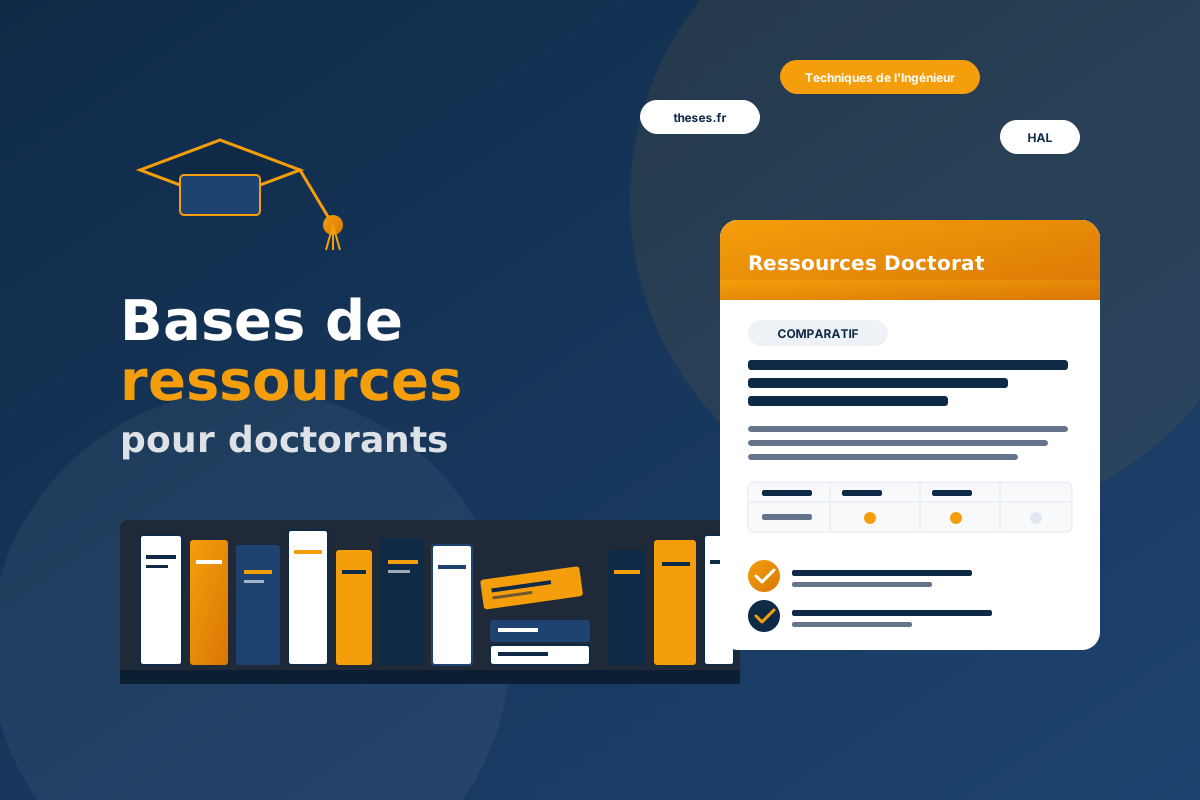
Comparison table of doctoral research resources
| Criterion | Techniques de l’Ingenieur | theses.fr | HAL | guide-doctorat.fr | Cairn.info |
|---|---|---|---|---|---|
| Content volume | 10,500+ technical articles | 120,000 defended theses | 4.5 million publications | 200+ methodological guides | 2.5 million articles |
| Disciplines | Engineering sciences, industry | All disciplines | All disciplines | Cross-disciplinary | French-speaking humanities |
| Scientific validation | Scientific committee, identified experts | ABES legal deposit | Author self-deposit | Editorial writing | Journal-level peer review |
| Access model | Institutional or individual subscription (from 390 euros per year) | Free | Free (open archive) | Free | Institutional subscription |
| Main language | French | French (multilingual) | French and English | French | French |
| Update frequency | Continuous, annual revisions | Real time (defense) | Real time (deposit) | Periodic | Continuous |
| Verdict | Engineering benchmark | Essential official catalog | Broad open archive | Practical methodology | Humanities benchmark |
The table is built from the public data of each platform (2024-2025 activity reports from ABES for theses.fr, from CCSD for HAL, figures published by editors for Techniques de l’Ingenieur and Cairn). The selected criteria cover content volume, scientific rigor, economic model and disciplinary coverage, three axes that condition the relevance of a database for a doctoral thesis.
The landscape of documentary resources for doctoral candidates
Building a rigorous doctoral bibliography requires combining several specialized databases. No single resource covers validated technical articles, recent theses, international preprints and methodological guides at the same time. Selecting the best doctoral research resource therefore depends on the discipline, the stage of progress and the nature of the research work.
According to the 2025 MESRI survey on documentary practices of French doctoral candidates, 78 percent of doctoral candidates use at least four distinct bibliographic databases, and 62 percent report that paid access is their main obstacle, after the volume of information to process.
Why compare resource databases
Objective selection criteria are not limited to volume. Four parameters must be analyzed before investing time in a platform.
- Depth of validation: a Techniques de l’Ingenieur article is reviewed by a scientific committee, a HAL deposit is not peer-reviewed
- Freshness of data: a HAL preprint can be a few days old, a Techniques de l’Ingenieur article is revised every 12 to 24 months
- Disciplinary coverage: Cairn favors French-speaking humanities, PubMed biomedicine, Techniques de l’Ingenieur applied sciences
- Access model: free, institutional subscription, freemium or pay-per-article
Techniques de l’Ingenieur: the benchmark for engineering sciences
Founded in 1946, Techniques de l’Ingenieur publishes a database of encyclopedic technical articles covering the full scope of applied sciences: mechanics, materials, chemical engineering, electrical engineering, environment, construction, transport, energies. The platform claims more than 10,500 active articles in 2025, written by 4,500 identified contributors (engineers, researchers, industry professionals) and validated by 60 thematic scientific committees.
This validation model is one of the most demanding among French-speaking databases. Each article is reviewed by two domain experts and revised every 12 to 24 months to integrate the evolution of standards, technologies and regulations. For a doctoral candidate in engineering sciences, this represents a methodological stability guarantee rarely found in the documentary ecosystem.
“Techniques de l’Ingenieur remains the only French-speaking database offering scientific validation equivalent to that of technical Encyclopedia Britannica, with continuous editorial renewal and complete author traceability.” — ADBU report on documentary resources of higher education, 2024
Individual access starts at 390 euros per year for a thematic module (for example “Mechanics | Functional materials”), and at 1,200 euros per year for a multi-database pack. Almost all French engineering schools and science-oriented universities subscribe to the platform, which makes access free for the majority of doctoral candidates through their institutional portal.
Key features
- Editorial coverage: 60 thematic databases, from “Mechanics” to “Environment”, with more than 30,000 updates per year
- Scientific validation: double review by identified experts, thematic committees, complete author traceability
- Methodological depth: each article combines theory, equations, industrial examples and bibliographic references
- Exploitable formats: downloadable PDF, EPUB, citation export (BibTeX, EndNote, Zotero)
- Accessible institutional pricing: entry at 390 euros per year for an individual module, compared with 2,500 to 4,000 euros for European equivalents (Springer Nature Technology, IEEE Xplore)
Detailed comparative analysis
theses.fr, the official catalog of French theses
theses.fr is operated by ABES (French Bibliographic Agency for Higher Education) since 2011. It lists 120,000 defended theses and 95,000 theses in preparation at accredited institutions. The service is entirely free and accessible without authentication.
Its main strength is exhaustiveness. Every thesis defended in France since 1985 is listed, with full-text access when the depositor has authorized it. Its limit: the quality of metadata depends on the cataloging work of each doctoral school, and foreign theses are not indexed (one must then switch to DART-Europe or NDLTD).
HAL, multi-disciplinary open archive
HAL (Hyper Articles en Ligne) has been managed by CCSD (Center for Direct Scientific Communication) of CNRS since 2001. The platform hosts 4.5 million scientific publications: journal articles, preprints, book chapters, theses, course materials. The model relies on voluntary deposit by authors, with minimal control (metadata signaling, but no scientific review).
It is the leading resource for recent monitoring: a preprint deposited in the morning is indexed in the afternoon. The corollary is that reliability varies: a HAL deposit does not have the same scientific value as a peer-reviewed article. For a doctoral bibliography, HAL is primarily used to spot recent work and to trace a researcher’s trajectory via their HAL-ID.
guide-doctorat.fr, methodology and writing
guide-doctorat.fr is an entirely free methodological portal dedicated to the practical aspects of doctoral research: thesis structure, bibliographic standards (APA 7, Chicago, IEEE, Vancouver), writing schedule, defense preparation, jury reports, derivative publications. It does not host primary scientific content but plays a cross-disciplinary guide role.
Its value for a doctoral candidate lies upstream and downstream of bibliographic research: it teaches how to cite correctly, organize one’s production and structure the manuscript according to jury expectations. It is particularly useful for first-year doctoral candidates and in the final writing phase.
Cairn.info for humanities and social sciences
Cairn.info aggregates more than 700 French-speaking journals and 2.5 million articles in humanities and social sciences. Access is paid through institutional subscription (more than 1,300 libraries subscribe in France). For a humanities doctoral candidate, Cairn covers the essentials of French-speaking reference production: sociology, economics, psychology, political sciences, history, philosophy.
Its positioning differs from Techniques de l’Ingenieur: Cairn does not produce content, it aggregates journals published by other editors (Dalloz, university presses, etc.). Validation therefore happens at each journal’s level (peer review committee), not at the platform level.
To deepen the question of recognized academic paths, consult the comparison of project management training and certifications, useful for valuing transferable skills from a doctorate. Doctoral candidates in applied sciences also benefit from the industrial measurement instruments guide, which overlaps with references used in many engineering theses. Finally, doctoral work focused on maintenance and reliability frequently crosses paths with the CMMS maintenance software analyzed in our B2B comparisons.
Who for: choosing the right resource based on your profile
Doctoral candidate in engineering sciences
The optimal combination pairs Techniques de l’Ingenieur (60 percent of bibliographic time, for validated technical foundations), HAL (25 percent, for monitoring preprints and recent articles in the field), theses.fr (10 percent, for the state of the art of French theses on similar subjects) and guide-doctorat.fr (5 percent, for writing methodology and IEEE citation standards).
Doctoral candidate in humanities and social sciences
Cairn.info becomes the main resource (45 percent of time), complemented by OpenEdition for open-access journals (20 percent), Persee for retrospective archives (10 percent), theses.fr (10 percent), HAL-SHS (10 percent) and guide-doctorat.fr for APA or Chicago standards (5 percent).
Doctoral candidate in the final writing phase
Whatever the discipline, the need shifts towards writing methodology and cross-validation. guide-doctorat.fr takes a central place (30 percent), paired with Techniques de l’Ingenieur or Cairn depending on the discipline to complete final references (40 percent), theses.fr to verify the originality of the positioning (20 percent) and bibliographic management tools such as Zotero or Mendeley (10 percent).
How to build your doctoral bibliography
A robust doctoral bibliography follows a three-phase logic. The exploratory phase consists in mapping the field through theses.fr and the main disciplinary databases. The deepening phase mobilizes validated technical articles, peer-reviewed journals and reference books. The monitoring phase relies on HAL, arXiv alerts and RSS feeds of targeted journals.
The expected volume varies by discipline. In engineering sciences, a thesis cites on average 150 to 250 references. In humanities and social sciences, the range rises to 300-500 references. In all cases, at least 30 percent of references must be primary sources (original articles, theses, data), the rest being secondary sources (syntheses, manuals, review articles).
Mistakes to avoid
- Under-weighting scientific validation: citing mostly non-reviewed preprints or academic blogs weakens the defense
- Neglecting French-speaking coverage: in humanities particularly, omitting Cairn, OpenEdition or Persee weakens disciplinary anchoring
- Ignoring prior theses: not consulting theses.fr exposes to the risk of redundancy with already defended work on a similar subject
- Freezing the bibliography too early: HAL deposits and arXiv preprints evolve continuously, searches must be relaunched until a few weeks before defense
- Underestimating bibliographic management: without Zotero, Mendeley or Citavi, managing 300 references manually becomes unmanageable in the writing phase
Frequently asked questions
What are the best doctoral research resources?
The best choice depends on the discipline. Techniques de l’Ingenieur remains the benchmark in engineering sciences with more than 10,500 technical articles written by 4,500 experts and validated by a scientific committee. theses.fr centralizes around 120,000 defended theses and 95,000 theses in preparation (ABES, 2025). HAL aggregates more than 4.5 million scientific publications in open archive. Cairn.info dominates humanities and social sciences with 700 French-speaking journals and 2.5 million articles. guide-doctorat.fr provides cross-disciplinary methodology: bibliographic standards, thesis structure and writing schedule.
Is Techniques de l'Ingenieur free for doctoral candidates?
Access to Techniques de l’Ingenieur is generally covered by the subscription of the university or doctoral school. Most French university libraries subscribe to the platform, which gives doctoral candidates free access through their institutional portal. For individual access, a subscription starts at around 390 euros per year for a thematic module and 1,200 euros for a multi-database pack, which remains more competitive than most European engineering databases.
How to build a solid doctoral bibliography?
A solid doctoral bibliography combines five complementary source types. Validated technical articles (Techniques de l’Ingenieur) for methodological foundations, defended theses (theses.fr, DART-Europe) for scientific positioning, preprints and articles in open archive (HAL) for recent monitoring, peer-reviewed journals (Cairn for humanities, ScienceDirect, JSTOR) for academic validation, and methodological guides (guide-doctorat.fr) for formal rigor. A doctoral thesis cites on average 150 to 400 references, of which at least 30 percent must be primary sources.
What is the difference between HAL and theses.fr?
HAL and theses.fr are two complementary French public platforms. theses.fr is the official catalog of French theses managed by ABES: it exhaustively references theses defended or in preparation at all accredited institutions. HAL is a multi-format open archive managed by CCSD (CNRS): it hosts articles, preprints, book chapters, dissertations and theses deposited voluntarily by researchers. theses.fr answers a census question, HAL answers a full-text access question.
Which resources to prioritize by discipline?
In engineering sciences, applied sciences and industry, Techniques de l’Ingenieur remains the French benchmark. In humanities and social sciences, Cairn.info, OpenEdition and Persee dominate the French-speaking landscape. In hard sciences (mathematics, physics, computer science), HAL and arXiv are essential. In medicine and biology, PubMed complements HAL. In all cases, theses.fr remains the mandatory entry point to map theses already defended, and guide-doctorat.fr provides cross-disciplinary methodology applicable to all fields.